
 Parenting Tips

Parenting Tips
25 Screen-Free Activities for Kids That Are Fun and Easy
October 20, 2026
Related
Topics

Hey
-
25 Screen-Free Activities for Kids That Are Fun and Easy
October 20, 2026
-

Modeling Emotional Intelligence as a Parent – Easy Realistic Tips
September 8, 2026
-
‘Name It to Tame It’ — How to Build Child’s Emotional Vocabulary
August 19, 2026
-
The 5 Super Steps of Emotion Coaching — Your Practical Guide
August 5, 2026
-
The 4 Famous Parenting Styles — Which One Is Yours?
June 22, 2026
Ready for more?
Hey
Sign up for Rainbow Kiddies newsletters for more stories and updates
Looking for ways to keep your little ones entertained without screens? Discover 25 simple, exciting screen-free activities for kids that encourage creativity, movement, learning, and meaningful family connections!
“I’m bored!”
If you’re a parent, you’ve probably heard these two words more times than you can count. And when you’re juggling work, household responsibilities, and parenting, handing your child a phone or tablet can feel like the easiest solution.
But what if some of the most enjoyable childhood experiences don’t require a screen at all?
Some of these everyday moments that we suggest here offer children opportunities to explore their imagination, practice important life skills, and connect with the people around them.
According to the American Academy of Pediatrics (AAP), play supports children’s language, social, emotional, and problem-solving development. The organization also encourages families to make time for playful learning and unstructured activities.
The good news? You don’t need expensive toys, elaborate setups, or hours of preparation to make screen-free time enjoyable.
Here are 25 fun and easy screen-free activities for children aged 3–8, including indoor games, outdoor adventures, creative projects, and activities that help children understand their feelings.
Why screen-free play matters for young children
Screens can be useful tools for education, entertainment, and staying connected. The goal isn’t necessarily to eliminate them but to create a healthy balance that leaves enough time for other important childhood experiences.
The World Health Organization recommends that children aged 3–4 have at least 180 minutes of varied physical activity throughout the day, including at least 60 minutes of moderate-to-vigorous activity, and no more than one hour of sedentary screen time daily.
For children aged 6–17, the CDC recommends at least 60 minutes of moderate-to-vigorous physical activity daily.
Screen-free play can create opportunities for children to:
- Develop creativity: Through imaginative games, art, and storytelling.
- Build social and emotional skills: By cooperating, taking turns, expressing feelings, and resolving disagreements.
- Stay physically active: Through dancing, running, jumping, and outdoor exploration.
- Practice problem-solving: By experimenting, building, and overcoming playful challenges.
- Strengthen family relationships: Through shared experiences and meaningful conversations.
These benefits are supported by the broader research on play and child development, although the outcomes of individual activities vary from child to child.
And the best part? Children often develop these skills naturally while having fun!
25 fun screen-free activities for kids aged 3–8
Creative arts and imagination
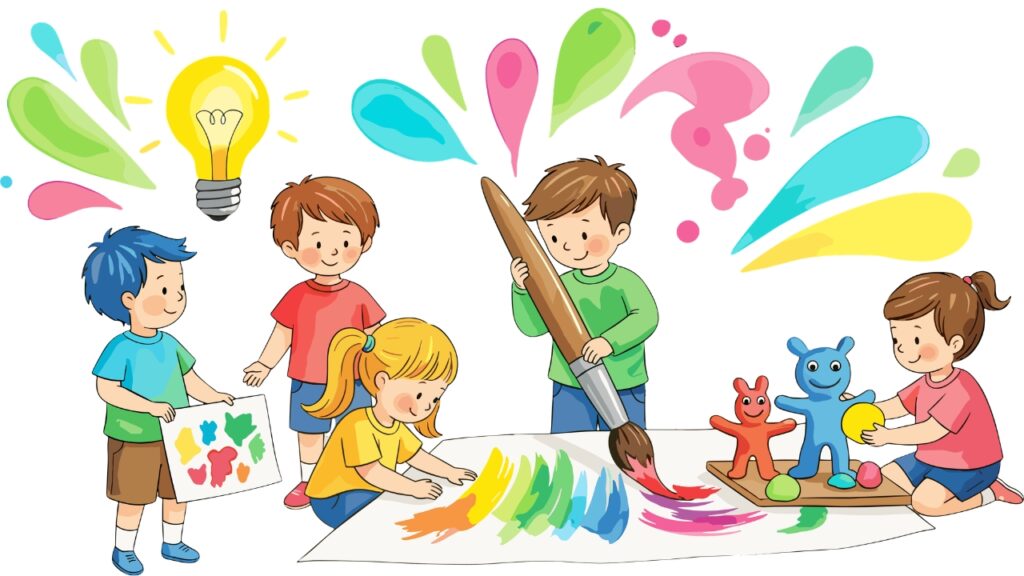
1. Create your own masterpiece
Ages 3–8 | 15–30 minutes
Bring out some paper, crayons, washable paints, or colored pencils, and let your child’s imagination take over. This is something we have been doing since my child learned to hold colors/ pencil. If I was working, I just made sure she was nearby and within a designated area to reduce mess. Now that she is older, she manages her own mess and I have little to worry about.
One way you can make it super interesting for them is, instead of telling them what to draw, try asking:
“What would your dream playground look like?”
“If you could invent a new animal, what would it be?”
Younger children can experiment with colors and shapes, while older children can create detailed scenes or comic strips. They may start something and not finish it – their whims and fancies could be fleeting, but let them be their own creative person.
Learning opportunity: Creative expression, fine motor practice, and imaginative thinking.
2. Build a magical blanket fort
Ages 3–8 | 20–40 minutes
This is something my 8 year old and her friends love to do by themselves or even during play-dates.
Turn your living room into a secret hideaway using bed sheets, cushions, and lightweight furniture.
Once the fort is ready, it can become a castle, spaceship, jungle camp, or cozy reading corner.
Let your child decide what happens inside their magical world.
Learning opportunity: Planning, teamwork, creativity, and problem-solving.
3. Put on a puppet show
Ages 3–8 | 20–30 minutes
Use socks, paper bags, or homemade paper puppets to create funny characters. You even get to buy small finger/ hand puppets at really low prices.
Encourage your child to invent a story with a beginning, middle, and end.
For an added twist, ask the characters to solve a problem together. Perhaps two friends want the same toy, or one puppet is feeling left out.
You could set up a small stage using a chair with a cloth over it as shown in the image below. You can fold the cloth and leave space for them to put in their little hands from behind and manage the puppets. You could even take turns to keep it interactive and fun for them. Ask questions, laugh along and just watch them giggle and laugh with joy. 🙂

Learning opportunity: Storytelling, communication, empathy, and perspective-taking.
4. Make something amazing from recycled materials
Ages 4–8 | 20–45 minutes
Save clean cardboard boxes, paper rolls, and other safe recyclable materials for a creative building challenge. Every time we get something delivered, the cardboard boxes get confiscated by the little human in our house. She makes doll houses with them, boxes for her colors, pencils, books and toys. If they are big enough, she even sits inside them and colors all the walls away. We had even made bags out of some old clothes and cardboard at one point.
You could even make rockets or pencil boxes/ holders from cylindrical cardboard left after paper rolls get used up. So the options are many and ask your little one. I am sure they’d be able to come up with still more ideas.
Encourage them to experiment and find solutions when their creations don’t work as planned.
Learning opportunity: Creativity, resourcefulness, and early engineering thinking.
5. Start a pretend-play adventure
Ages 3–8 | 20–40 minutes
Transform a corner of your home into a restaurant, supermarket, hospital, or animal rescue center.
Children can take turns being customers, doctors, shopkeepers, or veterinarians.
You can even introduce simple challenges:
“Oh no! The restaurant has run out of apples. What should we do?”
When my little one was small, we mostly played supermarket using her vegetables and other toys. That really helped her understand to use money as well. She is our go-to checkout expert at the supermarket now.
Now since she is older, we play a lot of hospital – mostly her dolls coming in sick. We take turns doing voice-over for the doctor and patient. While it is definitely funny, it does help her learn a thing or two about how to take care of someone who is sick, how to help, etc.
Learning opportunity: Social interaction, language development, cooperation, and flexible thinking.
Movement and outdoor adventures
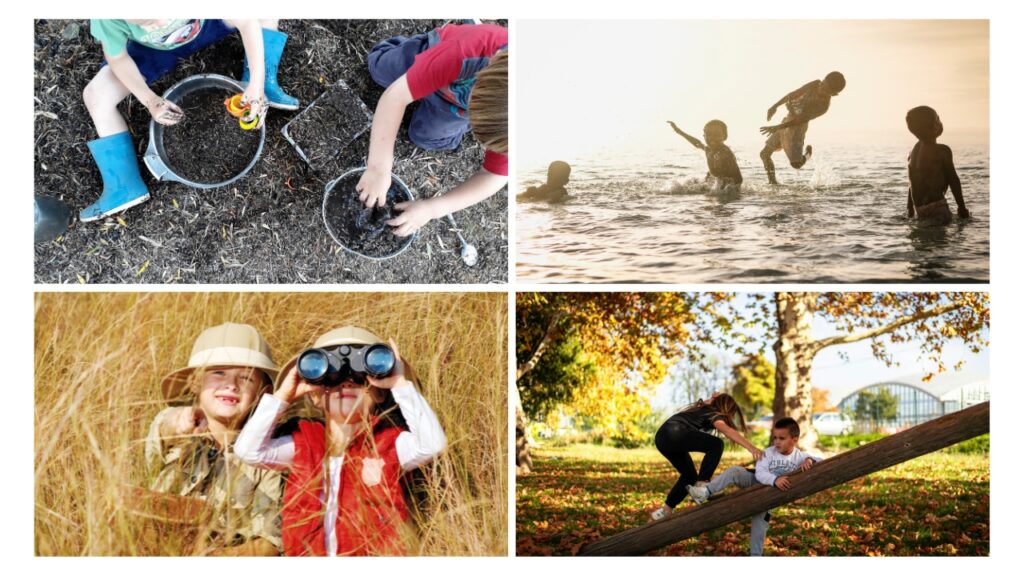
6. Go on a nature treasure hunt
Ages 3–8 | 20–40 minutes
Head to a nearby park, garden, or outdoor space with a simple list of things to discover.
Can your child find a yellow flower, a smooth stone, three different leaves, or something that makes an interesting sound? You could play ‘I spy’ while on the way or at the location itself.
Younger children can search for colors and shapes, while older children can record observations or sketch their discoveries. Make sure to take a little book and pencil with you. You could even write a little poem about what you see on this quick trip.
Remember to observe plants and insects respectfully without disturbing them. Help them learn that they are for everyone’s eyes and plucking is not kind.
Learning opportunity: Observation, curiosity, attention, and appreciation for nature.
7. Create an indoor obstacle course
Ages 3–8 | 15–25 minutes
Use cushions, floor markers, and soft toys to create an exciting obstacle course.
My child used to line up pillows and cushions to play ‘The Floor is Lava’. She used to walk over them and make us take the course too.
Children can also jump over a line, crawl through a cardboard tunnel, balance along a taped path, step on patterns on the floor tiles, and toss soft balls into a basket. Even mindful walking is something you could do to make walking more fun.
Change the course every few rounds (if possible) to keep things interesting.
Learning opportunity: Coordination, balance, motor planning, and perseverance.
8. Have a dance-and-freeze party
Ages 3–8 | 10–20 minutes
Play some music and encourage everyone to dance.
When the music stops, everyone must freeze in their funniest pose!
Add variations such as dancing like animals, moving slowly like robots, or pretending to float like astronauts.
Music can come from a radio or audio player, so there’s no need to watch a screen.
Learning opportunity: Listening, movement, self-control, and body awareness.
9. Try a kids’ yoga adventure
Ages 3–8 | 10–20 minutes
Turn simple yoga movements into an imaginative journey.
Ask your child to stretch tall like a tree, arch gently like a cat, rest in Child’s Pose, or stand strong like a warrior.
Create a story around the movements:
“We’re walking through a magical forest. Look! There’s a tall tree. Can you become a tree too?”
Keep the movements gentle and comfortable, without forcing stretches or expecting perfect poses. We have 2 video which guide kids on how to do easy yoga poses. Watch them on YouTube – Yoga Poses for Kids Part 1 and Yoga Poses for Kids Part 2.
Learning opportunity: Body awareness, balance, coordination, and opportunities for relaxation.
10. Play classic outdoor games
Ages 3–8 | 20–40 minutes
Sometimes the simplest games are the most enjoyable.
Try hopscotch, follow-the-leader, hide-and-seek, or a gentle game of catch, or tag. If you are into swimming you could chase each other or play ball in the pool. Kids who enjoy being in water would love such games for sure.
You can adapt the rules to your child’s age and abilities.
For example, younger children can hop between large floor markers, while older children can create their own hopscotch patterns. Same goes for swimming too – design your games to suit their swimming capabilities. You could even play shuttle, go cycling with them, etc.
Learning opportunity: Physical activity, cooperation, turn-taking, and following instructions.
Learning through play
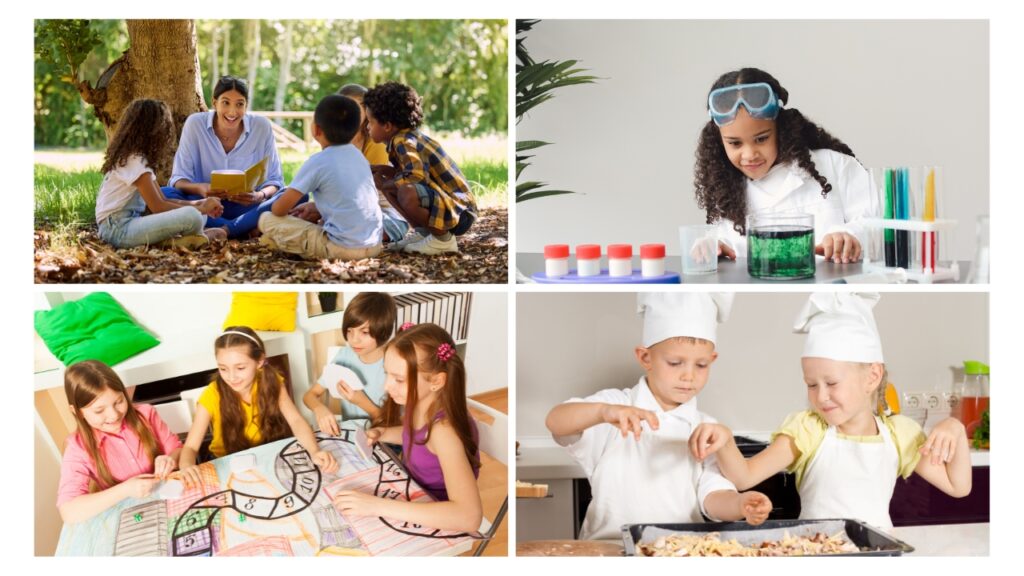
11. Enjoy a storytelling adventure
Ages 3–8 | 15–25 minutes
Reading together is a wonderful way to slow down and connect.
Choose a story with engaging characters and pause occasionally to ask questions.
“How do you think this character is feeling?”
“What would you do if you were in their place?”
“What do you think will happen next?”
Younger children can describe pictures, while older children can predict endings or invent alternative story-lines. Children also tend to like rereading the same book because it gives them a feeling of knowing something and hence, safety. It will be really cute to see them wait for a page to come up, and then add their two cents to share what they know really well in there.
Learning opportunity: Vocabulary, comprehension, imagination, and emotional understanding.
A little Rainbow Kiddies inspiration: Our children’s books bring everyday experiences to life through relatable stories featuring Moon and her friends.
For example, The Play-date Fix explores sharing and assertiveness, while Moon Welcomes a New Sibling & Discovers Her Superpowers opens conversations about family changes and feelings.
Explore our collection of Rainbow Kiddies children’s books and make storytelling a meaningful part of your family’s screen-free routine.
12. Become a little scientist
Ages 4–8 | 15–30 minutes
Turn your kitchen or living room into a mini science laboratory.
Try a simple sink-or-float experiment using a bowl of water and safe household objects.
Before testing each item, ask:
“Do you think this will sink or float? Why?”
Let your child make predictions, test their ideas, and talk about the results. There are several YouTube channels and websites which list safe experiments that kids can do at home. Just make sure you are around to guide and support them through these activities.
Learning opportunity: Curiosity, observation, prediction, and early scientific reasoning.
13. Play sorting and matching games
Ages 3–6 | 10–20 minutes
Gather blocks, large buttons for older children, toy animals, or colorful household objects.
Ask your child to sort them by color, shape, size, or category.
For older children, add challenges such as creating patterns or sorting objects using two rules. You could even get them to help with sorting their toy shelves occasionally.
Learning opportunity: Classification, early mathematics, and logical thinking.
14. Become a junior chef
Ages 3–8 | 20–40 minutes
Invite your child to help prepare a simple snack.
They can wash fruit, mix ingredients, spread soft toppings, or arrange colorful foods on a plate.
Ask questions such as:
“How many strawberry pieces do we have?”
“What colors can you see?”
“What do you think will happen when we mix these ingredients?”
It would be even better if you get them to make something that they don’t really like. They might just feel an urge to eat it since they made it themselves. It might also help change any misconceptions that they might have about that dish or food.
Keep knives, hot surfaces, and choking hazards under appropriate adult supervision.
Learning opportunity: Independence, counting, sequencing, and everyday life skills.
For more food-themed fun, Rainbow Kiddies’ Superhero Food Story introduces children to healthy eating through Moon’s adventures, interactive missions, and simple recipes.
15. Explore a kids’ newspaper together
Ages 5–8 | 15–25 minutes
Introduce your child to the fascinating world around them through age-appropriate news and interesting facts.
Read a short story together and ask:
“What surprised you?”
“What would you like to learn more about?”
“Can you draw something you discovered today?”
For younger children, parents can read aloud, explain unfamiliar words, and focus on pictures or simple facts.
Rainbow Kiddies idea: Our weekly newspapers offer another way to encourage curiosity and learning beyond screens. Families can use them as conversation starters, general knowledge builders, reading activities, or inspiration for drawing and storytelling.
Discover more through Rainbow Kiddies.
Emotional well-being and mindfulness
16. Create a feelings chart
Ages 3–8 | 15–25 minutes
Draw different facial expressions representing happiness, sadness, anger, worry, excitement, and frustration.
Invite your child to name each emotion and share a time they felt that way.
You might ask:
“When do you feel really happy?”
“What helps you when you’re upset?”
Remind your child that all feelings are welcome, even when some behaviors need limits. Explore our book on feelings to help kids learn about different basic feelings, and how to spot them in themselves and others.
Learning opportunity: Emotional vocabulary, self-awareness, and communication.
17. Make a calm-down jar
Ages 4–8 | 15–20 minutes
Fill a clear, tightly sealed plastic bottle with water, a little glitter glue, and large decorative shapes suitable for the activity.
Shake it gently and watch the contents settle.
Use this as an opportunity to talk about how big feelings can sometimes make our thoughts feel busy.
You might say:
“Just like the glitter takes time to settle, sometimes we need a little time to feel calmer.”
Keep the bottle securely sealed and supervise its use. Keep this in their calm down corner and there it is, their reusable calming toy.
Learning opportunity: Emotional awareness and practicing a calming routine.
18. Practice flower breathing
Ages 3–8 | 5–10 minutes
Ask your child to imagine holding a beautiful flower.
Invite them to gently breathe in as though smelling the flower, then breathe out slowly as though blowing a feather.
Repeat a few times at a comfortable pace.
Children can also draw their imaginary flower and give it a name. We have more breathing exercises here, just in case you’d interested in exploring more options.
Learning opportunity: Body awareness, focused attention, and a simple strategy children can practice when they want to settle.
19. Play the kindness challenge
Ages 3–8 | Throughout the day
Challenge your child to complete three small acts of kindness.
They might help put away toys, make a card for someone, thank a family member, or invite another child to join a game.
At the end of the day, talk about what happened.
“How did you feel when you helped someone?”
“How do you think the other person felt?”
Our gratitude journal will be a great guide for you and your kids in this activity. It doesn’t just ask questions like we have mentioned above, it also helps kids understand gratitude and how to express it too. It has multiple activities/ games likes gratitude jars, trees, words, etc.
Learning opportunity: Empathy, consideration, gratitude, appreciation, and social awareness.
20. Work together on a puzzle
Ages 3–8 | 15–30 minutes
Choose an age-appropriate jigsaw puzzle or make your own by drawing a picture on cardboard or thick paper, and cutting it into large pieces. You also get to buy plain puzzle pieces on which kids can make their own drawings and then play. This might turn out to be extra engaging for them, since it’s their own ideas and creativity that they get to play with.
Encourage children to look for colors, shapes, and patterns.
If they become frustrated, offer gentle encouragement rather than completing the puzzle for them.
Learning opportunity: Visual reasoning, persistence, collaboration, and problem-solving.
Family bonding and everyday adventures
21. Have an indoor picnic
Ages 3–8 | 20–40 minutes
Spread a blanket on the living room floor, prepare some simple snacks, and pretend you’re having a picnic in a beautiful garden.
Let your child help pack the picnic basket, arrange the food, and decide where everyone should sit.
For extra fun, invite a few stuffed animals! Have some board games handy too.
Learning opportunity: Planning, cooperation, communication, and family connection.
22. Grow a little garden
Ages 3–8 | 15 minutes to start, then daily care
Plant a few easy-to-grow seeds in a small pot.
Encourage your child to water them appropriately, observe changes, and keep a simple plant diary.
Older children can measure growth, while younger children can draw what they see. They could be encouraged to use reusable materials to help them learn how to reduce trash.
Ask: “What do you think plants need to grow?”
Learning opportunity: Responsibility, patience, observation, and understanding nature.
23. Make a gratitude tree
Ages 3–8 | 15–25 minutes
Draw a large tree on paper and cut out leaf shapes.
Ask your child to name something they appreciate, such as a friend, family member, favorite activity, or happy memory.
Write or draw one thing on each leaf and add it to the tree.
Over time, your tree can become a colorful collection of meaningful moments. You could even put this up in their calm down corner or play room. As the tree grows, so will their appreciation and gratitude.
Learning opportunity: Reflection, emotional expression, gratitude, and recognizing positive experiences.
24. Invent a family board game
Ages 5–8 | 30–45 minutes
Use cardboard, crayons, and simple counters to create a homemade board game.
Children can design the playing path, invent challenges, and decide the rules.
For younger children, keep the game simple with colors, pictures, and a few spaces.
Try adding fun prompts:
“Name something that makes you happy.”
“Do five silly jumps!”
“Share one kind thing you did today.”
Or even better, get the kids to design and make the game. It might not out to be a perfectly playable game always, but they will sure have something to satiate their curiosity and creative juices for a couple of days.
Learning opportunity: Creativity, counting, turn-taking, and decision-making.
25. Create a family memory box
Ages 3–8 | 20–30 minutes
Decorate a small box and fill it with drawings, photographs, postcards, or written notes about happy family moments.
Every few weeks, open the box together and revisit the memories.
Ask your child:
“What was your favorite part of that day?”
“Why do you think this memory is special?”
This is almost like the Google Photos that keep showing memories to you daily. The physical memory box will definitely be great for young kids.
Learning opportunity: Storytelling, reflection, emotional connection, and appreciation.
How to make screen-free time a daily habit
You don’t need to organize 25 activities in one week! Small, consistent changes are often easier for families to maintain than a complete overhaul of their routines.
Here are a few ways to get started:
Create a screen-free activity basket. Fill it with crayons, paper, picture books, puzzles, and simple craft supplies. Let your child choose what interests them.
Start with 15–20 minutes. Choose a manageable period when screens are put away and everyone can focus on playing, creating, or connecting.
Let your child lead. Children don’t always need adults to plan every minute. Give them room to explore their own ideas.
Make it a family experience. Even ten minutes of attentive play together can become a meaningful part of your routine, and give quality time together.
Welcome a little boredom. Instead of immediately providing entertainment, invite your child to think of something they’d like to create or explore. In case they cannot think of something, you have this list. This list of activities is such that you can come back to it anytime you run out of ideas or need quick pointers. So keep it saved.
Most importantly, remember that screen-free time shouldn’t feel like a punishment. It should feel like an invitation to discover something wonderful!
Take screen-free learning further with Rainbow Kiddies
At Rainbow Kiddies, we believe childhood should be filled with curiosity, creativity, kindness, and meaningful connections.
Our stories, learning resources, and interactive experiences are designed to support children’s social and emotional development while making learning enjoyable.
Explore our children’s books.
From friendships and assertiveness to kindness, gratitude, and managing emotions, our books give families opportunities to explore important life lessons through storytelling.
Read together, discuss the characters, and recreate favorite scenes through pretend play.
Also our online workshops are available to families across the globe, while our in-person workshops are offered in Singapore only.
These experiences provide opportunities for children to learn, express themselves, and connect with others through engaging activities.
Explore Rainbow Kiddies workshops
Make learning a weekly adventure
Our weekly newspapers will not just increase their general knowledge, but also inspire conversations, reading practice, and creative activities at home.
Try turning a newspaper topic into a drawing challenge, a family discussion, or a storytelling activity.
Discover more at Rainbow Kiddies
Final thoughts: The best childhood memories don’t need a screen
Children don’t need every moment of their day to be filled with elaborate activities or expensive entertainment.
Sometimes, the most memorable experiences come from the simplest things: building a fort with cushions, laughing during a family game, discovering an interesting insect, or sharing a story before bedtime.
Screen-free activities create opportunities for children to explore their world, express themselves, develop new skills, and strengthen relationships.
And remember, there’s no need to do everything perfectly.
Start with one activity. Follow your child’s curiosity. And enjoy the little moments together.
Because childhood isn’t just about keeping children busy. It’s about giving them opportunities to grow, connect, and discover the joy of being themselves.
Which screen-free activity will your family try first? We’d love to hear your ideas!




Frequently asked questions
1. How much screen-free time should children have each day?
There isn’t one universal screen-free target for every child aged 3–8. WHO recommends no more than one hour of sedentary screen time daily for children aged 3–4. For older children, families should consider screen use while keeping aside enough time for sleep, physical activity, school, social interaction, and other developmental needs.
2. What are the best screen-free activities for a 3-year-old?
Simple activities such as finger painting, pretend play, picture-book reading, dancing, building with large blocks, and exploring nature are excellent starting points. Choose materials suitable for your child’s developmental stage.
3. How can I keep a 6–8-year-old entertained without screens?
Try science experiments, homemade board games, obstacle courses, nature hunts, creative writing, gardening, and collaborative projects. Older children often enjoy helping to design the activity themselves.
4. What if my child refuses screen-free activities?
Start with something they already enjoy and make the transition gradual. Offer two appealing choices rather than an overwhelming number of options. Participating alongside your child can also make the experience more inviting. Even better, get them to decide or design a game.
5. Are screen-free activities better than educational apps?
Not necessarily in every situation. High-quality, age-appropriate digital content can have educational value. Screen-free play offers different opportunities, especially for physical movement, hands-on exploration, and face-to-face interaction. A balanced approach is more useful than treating all screen use as harmful.
Research and references
The article draws on the following authoritative resources:
1. World Health Organization (2019). Guidelines on Physical Activity, Sedentary Behavior and Sleep for Children Under 5 Years of Age. Evidence-based guidance on activity, sleep, and sedentary behavior.
2. American Academy of Pediatrics. The Power of Play: How Fun and Games Help Children Thrive. Discussion of play’s role in social, emotional, cognitive, and physical development.
3. American Academy of Pediatrics. The Importance of Playing With Your Child. Research-informed guidance on parent-child play and screen-free activities.
4. Centers for Disease Control and Prevention (2025). Child Activity: An Overview. Physical activity recommendations for preschool and school-aged children.
5. Centers for Disease Control and Prevention (2024). Making Physical Activity Part of a Child’s Life. Practical guidance on making movement enjoyable and age-appropriate.
Safety note: All activities should be adapted to each child’s developmental abilities, interests, and accessibility needs. Supervise activities involving water, craft materials, food preparation, and small objects. Suggested learning opportunities describe skills that activities may help children practice, not guaranteed outcomes.
Sign Up for your Free Parenting Guide: “10 Everyday Ways to Raise an Emotionally Strong Child”


