
 Parenting Tips
Parenting Tips
‘Name It to Tame It’ — How to Build Child’s Emotional Vocabulary
August 19, 2026
Related
Topics

Hey
-

25 Screen-Free Activities for Kids That Are Fun and Easy
October 20, 2026
-

Modeling Emotional Intelligence as a Parent – Easy Realistic Tips
September 8, 2026
-
‘Name It to Tame It’ — How to Build Child’s Emotional Vocabulary
August 19, 2026
-
The 5 Super Steps of Emotion Coaching — Your Practical Guide
August 5, 2026
-
The 4 Famous Parenting Styles — Which One Is Yours?
June 22, 2026
Ready for more?
Hey
Sign up for Rainbow Kiddies newsletters for more stories and updates
In our last blog, we walked through the five steps of Emotion Coaching. So, our next logical step is — Name it to Tame it – helping your child label their emotions. This is so powerful that it deserves a deep dive of its own. The ability to name what we feel isn’t just a communication skill; it’s a neurological intervention that changes the brain’s response to stress. This post explores the science behind emotional vocabulary, why precision matters, and practical ways to build this skill in children of all ages.
“Name It to Tame It”: The Neuroscience
Dr. Dan Siegel, clinical professor of psychiatry at UCLA and co-author of The Whole-Brain Child, popularized a phrase that has become a cornerstone of modern parenting: “Name It to Tame It.”
The concept is grounded in brain architecture. When a child experiences a strong emotion — say, for example, fury after a sibling takes their toy — the amygdala (the brain’s alarm system) fires, triggering the fight-or-flight response. In that moment, the prefrontal cortex — responsible for reasoning, impulse control, and perspective-taking — effectively goes offline. However, the child isn’t choosing to be unreasonable; their brain’s “upstairs” has been temporarily disconnected from its “downstairs.”
Here’s where naming comes in. Groundbreaking fMRI research by Lieberman et al. (2007), published in the journal Psychological Science, demonstrated that the simple act of putting feelings into words — a process called affect labeling— reliably reduced amygdala activation while simultaneously increasing activity in the right ventrolateral prefrontal cortex (RVLPFC), a brain region critical for emotional regulation. In plain English: when you help your child put what they’re feeling into words, you are physically calming their brain.
Siegel’s framework explains why this happens. The left hemisphere of the brain is the seat of language, logic, and linear thinking. Meanwhile, the right hemisphere processes emotion, imagery, and bodily sensation. When an emotional storm hits, the right brain is in overdrive. Hence, by naming the emotion, you engage the left brain — creating a bridge between raw feeling and rational processing. The emotion hasn’t disappeared, but it’s no longer running the show alone.
This is why saying “I can see you’re really angry that your tower fell down” works better than “Stop crying — it’s just blocks.” The first response engages the left brain and integrates the experience; the second leaves the right brain alone in the storm.
Beyond “Happy” and “Sad”: The Case for Emotional Granularity
Naming emotions is powerful, but naming them precisely is transformative.
Psychologist Dr. Lisa Feldman Barrett, a University Distinguished Professor at Northeastern University and author of How Emotions Are Made, introduced the concept of emotional granularity — the ability to make fine-grained distinctions in your emotional experiences. Someone with high granularity doesn’t just feel “bad”; they distinguish between disappointed, frustrated, embarrassed, lonely, and overwhelmed. Meanwhile, someone with low granularity experiences all of these as the same undifferentiated state.
Barrett’s theory of constructed emotion proposes that emotions aren’t hardwired circuits that simply “trigger”. Rather, they’re constructed by the brain using a combination of bodily sensations, past experience, and — critically — language. So, the words you have for emotions shape the emotions you can experience.
A landmark meta-analysis by Kashdan, Barrett, and McKnight (2015), published in Clinical Psychology Review, confirmed that higher emotional granularity is consistently associated with better mental health outcomes, including:
- More adaptive emotion regulation (less reliance on binge eating, substance use, or aggression when upset)
- Better ability to manage stressful life events
- Reduced depressive symptoms
- Greater psychological well-being
Negative Emotions and Granularity
A 2021 perspective article in Frontiers in Psychology summarized the evidence simply: “More granular experiences of negative emotions, especially, are consistently associated with better coping and mental health.”
For children especially, this plays out in remarkably concrete ways. A child who can say “I’m feeling left out” rather than just acting out with aggression is a child who has a pathway to a solution. Also, a child who can distinguish “I’m nervous” from “I’m excited” can deploy the right coping strategy. So, emotional vocabulary isn’t just descriptive — it’s functional. Further, it gives children a handle on their inner world.
A 2024 study published in the journal Early Education and Development found that regular picture book reading significantly increases both the frequency and diversity of emotion vocabulary that children use — a compelling case for reading as a tool to build granularity.
The RULER Approach: Teaching Emotional Vocabulary Systematically
If emotional granularity is the goal, how do we actually develop it? Dr. Marc Brackett, founding director of the Yale Center for Emotional Intelligence and author of Permission to Feel, has spent over two decades answering this question.
Brackett and his colleagues developed RULER, an evidence-based approach to social and emotional learning now implemented in over 2,500 schools across the United States and internationally. The acronym stands for:
- recognizing emotions in oneself and others
- Understanding the causes and consequences of emotions
- Labeling emotions with precise words
- Expressing emotions appropriately
- Regulating emotions effectively
What is a Mood Meter in RULER classrooms?
The “L” — Labeling — is the vocabulary engine. RULER classrooms use a tool called the Mood Meter, a square divided into four colored quadrants representing different categories of emotional experience:
- Red (high energy, unpleasant): anger, frustration, anxiety, fear
- Blue (low energy, unpleasant): sadness, disappointment, loneliness, exhaustion
- Yellow (high energy, pleasant): joy, excitement, optimism, pride
- Green (low energy, pleasant): calm, contentment, gratitude, serenity
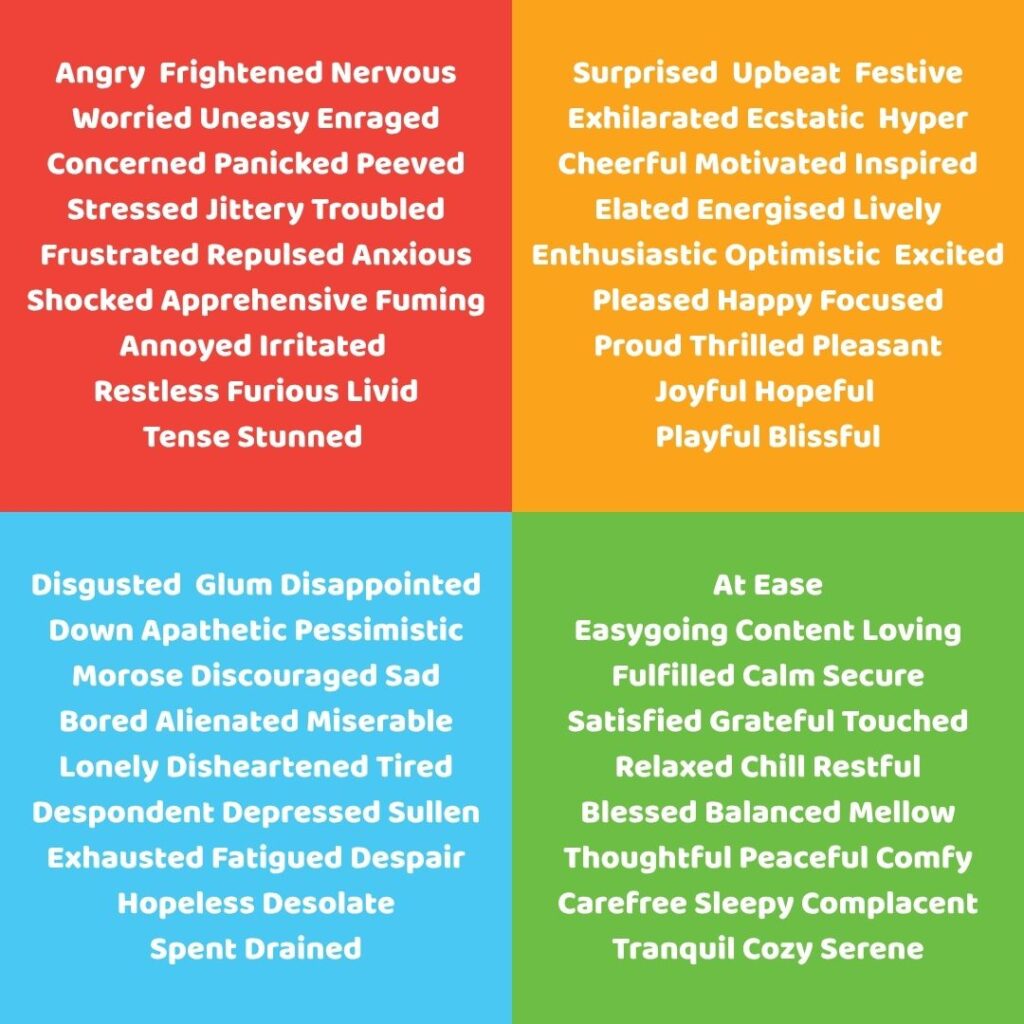
Children learn to plot their feelings on the Mood Meter throughout the day. The genius of this tool is that it teaches two dimensions of emotion simultaneously: valence (pleasant vs. unpleasant) and energy (high vs. low). A child who previously only had the word “mad” now has access to an entire quadrant of related but distinct feelings — frustration (red, high energy), irritation (red, moderate energy), annoyance (red-orange). So, this is emotional granularity in action.
Rivers and Brackett’s (2010) research found that children in RULER classrooms demonstrated greater emotion recognition skills and improved social behavior compared to peers in control classrooms. Further, a randomized controlled trial published in the Journal of Educational Psychology showed that RULER improved classroom climate, enhanced students’ emotional skills, and boosted academic performance — reinforcing that vocabulary isn’t separate from learning; it’s foundational to it.
Brackett’s core philosophy is captured in the title of his book: Permission to Feel. In this book, he argues that most of us have internalized, often from childhood, that certain emotions are unacceptable. We become what he calls “emotion judges” — critical of our own and others’ feelings — rather than “emotion scientists” — open, curious, and reflective. Giving children an expansive emotional vocabulary is, in essence, giving them permission to experience the full range of being human.
Susan David and Emotional Agility
Harvard Medical School psychologist Dr. Susan David, author of the bestselling Emotional Agility, adds another dimension to emotional vocabulary: it’s not just about naming emotions — it’s about how we relate to them.
David’s research emphasizes that emotional agility involves showing up to our emotions (rather than suppressing or brooding on them), stepping out (creating distance through observation rather than fusion), and walking our why (making choices aligned with our values, not our immediate emotional impulses).
However, her framework applies directly to parenting. When a child is struggling with a difficult emotion, an emotionally agile parent doesn’t say “Don’t be sad” or “Just think positive” — both of which are forms of emotional suppression associated with poorer outcomes. Instead, they help the child notice the emotion, name it accurately, and make a conscious choice about what to do with it.
So, David’s work reinforces a crucial point: building emotional vocabulary isn’t about giving children a clinical toolkit to analyze themselves into passivity. It’s about helping them develop a richer, more nuanced relationship with their inner life — so they can navigate the world with greater flexibility, resilience, and authenticity.
Practical Strategies: Building Emotional Vocabulary at Every Age
Here’s how to put the research into practice, adapted for different developmental stages.
Toddlers (2–4 years)
- Name their emotions for them, in the moment: “You’re feeling frustrated because the puzzle piece won’t fit. That’s really hard, isn’t it?”
- Use simple, consistent language: For example, start with the core four — happy, sad, angry, scared — and gradually introduce related words (frustrated, disappointed, nervous, excited).
- Read picture books with emotional content. The 2024 Early Education and Development study confirms that regular picture book reading significantly enriches children’s emotion vocabulary. Point to characters and ask: “So, how do you think the bunny feels right now?”
- Model your own labeling out loud: “Mummy is feeling a bit frustrated right now because the computer isn’t working. I’m going to take three deep breaths.”
Preschoolers and Early Primary (4–7 years)
- Introduce the concept of intensity: “Annoyed is like angry’s little cousin. Furious is when angry is very, very big.”
- Use an emotion wheel or a simplified Mood Meter. Print one out and put it on the fridge. Encourage your child to point to how they’re feeling — especially during calm moments, not just meltdowns.
- Play “Emotion Detective”: Watch a show together or look at a picture book and guess what characters are feeling based on their faces and body language. Ask: “How can you tell? What clues did you see?”
- Separate the feeling from the behavior: “It’s okay to feel jealous. It’s not okay to snatch. Let’s think of a better way.”
Older Children (8–12 years)
- Introduce nuanced distinctions: Can your child tell the difference between jealousy (wanting what someone else has) and envy (wishing they had what someone else has and resenting it)? Between shame (feeling bad about who you are) and guilt (feeling bad about something you did)? These distinctions unlock more targeted coping.
- Use a full Mood Meter to plot feelings daily. Discuss how feelings shift throughout the day — this teaches that emotions are temporary and fluid, not permanent states.
- Tell stories. As Dan Siegel recommends, when your child is upset, help them tell the story of what happened — with feeling words embedded throughout. This integrates the emotional right brain with the narrative left brain.
- Share your own emotional process (appropriately): “I was feeling really worried about my work presentation today. I noticed my shoulders were tight and my heart was beating fast. I took a walk and listened to music, and it helped me settle down.” This models the full arc: notice → name → regulate.
A Note on What NOT to Do
Research consistently warns against a few common pitfalls:
- Don’t rush to fix. When your child names a difficult emotion, resist the urge to immediately solve it. Sitting with the feeling — without judgment or urgency — is part of the skill.
- Don’t label FOR them long-term. The goal is independence. By age 7 or 8, shift from “You seem angry” to “What are you feeling right now? What’s the best word for it?”
- Don’t treat emotions as problems to eliminate. As Brackett says: there are no bad emotions. Anxiety alerts us to risk. Anger signals a boundary has been crossed. Sadness helps us process loss. The goal isn’t eradication — it’s fluency.
- Don’t demand emotional articulation in the heat of the moment. When a child’s amygdala is fully activated, they may not be able to access language. Regulate first (with your calm presence), then label.
The Payoff
A child with a rich emotional vocabulary grows into an adolescent who can say “I’m feeling really overwhelmed with exam pressure — I think I need to talk to someone” instead of acting out, withdrawing, or self-medicating. They become an adult who can navigate conflict in relationships with clarity rather than explosive reactivity.
The research is clear: this skill is protective. Kashdan, Barrett, and McKnight’s (2015) meta-analysis found that emotional granularity functions as a buffer against the worst effects of stress — not by eliminating difficult emotions, but by making them navigable. Every word you teach your child for their inner world is a tool they’ll carry for life.
Coming Up in Part 5
In the final post of this series, we’ll turn the lens onto you — the parent. How do you model emotional intelligence? We’ll explore Albert Bandura’s social learning theory, the Harvard Center on the Developing Child’s “Serve and Return” framework, Marc Brackett’s concept of becoming an “emotion scientist,” and practical strategies for regulating your own emotions so you can coach your child’s.
Sources Referenced in Part 4
- Siegel, D. J., & Bryson, T. P. (2012). The Whole-Brain Child: 12 Revolutionary Strategies to Nurture Your Child’s Developing Mind. Delacorte Press.
- Lieberman, M. D., Eisenberger, N. I., Crockett, M. J., Tom, S. M., Pfeifer, J. H., & Way, B. M. (2007). “Putting Feelings Into Words: Affect Labeling Disrupts Amygdala Activity in Response to Affective Stimuli.” Psychological Science, 18(5), 421–428.
- Barrett, L. F. (2017). How Emotions Are Made: The Secret Life of the Brain. Houghton Mifflin Harcourt.
- Kashdan, T. B., Barrett, L. F., & McKnight, P. E. (2015). “Unpacking Emotion Differentiation: Transforming Unpleasant Experience by Perceiving Distinctions in Negativity.” Current Directions in Psychological Science, 24(1), 10–16.
- Wilson-Mendenhall, C. D., & Dunne, J. D. (2021). “Cultivating Emotional Granularity.” Frontiers in Psychology, 12, 703658. Frontiers in Psychology
- Brackett, M. A. (2019). Permission to Feel: The Power of Emotional Intelligence to Achieve Well-Being and Success. Celadon Books.
- Rivers, S. E., & Brackett, M. A. (2010). “Achieving Standards in the English Language Arts (and More) Using The RULER Approach to Social and Emotional Learning.” Reading & Writing Quarterly, 27(1–2), 75–100.
- Yale Medicine (2020). “Why ‘Social and Emotional Learning’ Is So Important for Kids Right Now.” Yale Medicine
- David, S. (2016). Emotional Agility: Get Unstuck, Embrace Change, and Thrive in Work and Life. Avery.
- Towson, J. A., et al. (2024). “Picturebooks Increase the Frequency and Diversity of Emotion Vocabulary.” Early Education and Development.TandFOnline
- RULER Approach. Yale Center for Emotional Intelligence.




Sign Up for your Free Parenting Guide: “10 Everyday Ways to Raise an Emotionally Strong Child”


